

The Hidden Distortion of Financial Reality
Why what looks like strong revenue may be quietly holding your practice back.
On paper, your practice is thriving. Authorizations are up. Billed revenue is strong. Your clinical team is growing. Yet, month after month, the cash account tells a different story. Cash is tighter than it should be, more reliant on your line of credit, and harder to predict.
If that tension feels familiar, you’re not alone. One of the most persistent and misunderstood challenges in ABA isn’t clinical; it’s billing and payment lag, and it rarely shows up on an income statement until it’s already a problem.
The urgency is real. When your cash cycle breaks down, the ripple effects reach far beyond the balance sheet. Delayed reimbursement means delayed hiring, deferred expansion, and tighter budgets for the tools, training, and support that directly shape the quality of care your kiddos receive.
Understanding Billing & Payment Lag
Simply defined:
- Billing lag is the time between the date of service and the submission of a clean claim.
- Payment lag is the time from claim submission to payer reimbursement.
Together, they form your cash conversion cycle, which is the real heartbeat of an ABA provider’s financial health.
In an ideal world, claims go out within days of service, and payments arrive within contractual timelines. In reality, documentation gaps, authorization issues, credentialing delays, and payer-specific nuances stretch that cycle from days into weeks and even months.
The Illusion of Revenue
This is where lag becomes dangerous. Not because the money isn’t there, but because leadership believes it is.
Organizations may report strong billed revenue based on services rendered, but if claims are delayed or payments are stalled, cash flow tells a very different story. The business feels strong on the dashboard and strained in the checking account.
Common symptoms include:
- Increasing accounts receivable (A/R) days
- Growing aged A/R buckets (60, 90, 120+ days)
- Reliance on lines of credit despite “strong” revenue
- Unexplained fluctuations in monthly cash collections
Without visibility into lag metrics, these warning signs are often misattributed to payer behavior rather than internal inefficiencies.
Operational Root Causes
Billing and payment lag is rarely caused by a single issue; it’s typically the result of compounding operational gaps:
- Delayed session note completion and sign-off
- Authorization mismatches or expirations
- Credentialing misalignment with payer requirements
- High denial rates due to preventable errors
- Lack of ownership in A/R follow-up
Each of these extends the revenue cycle timeline, creating a backlog that masks your organization’s actual earning capacity.
Why Lag Distorts Financial Decision-Making
When leadership relies on billed revenue instead of collected revenue, strategic decisions drift out of sync with financial reality.
- Hiring decisions may outpace actual cash flow.
- Expansion plans may be approved on inflated revenue assumptions.
- Cost controls may be delayed because margins appear stronger than they are.
In effect, lag acts as a financial fog, obscuring true performance and increasing risk exposure. And because ABA is a mission-driven field, the stakes aren’t just financial. Every dollar stuck in A/R is a dollar not invested in BCBA supervision hours, RBT development, parent support, or the everyday improvements that make each kiddo’s care experience better.
Key Metrics to Monitor
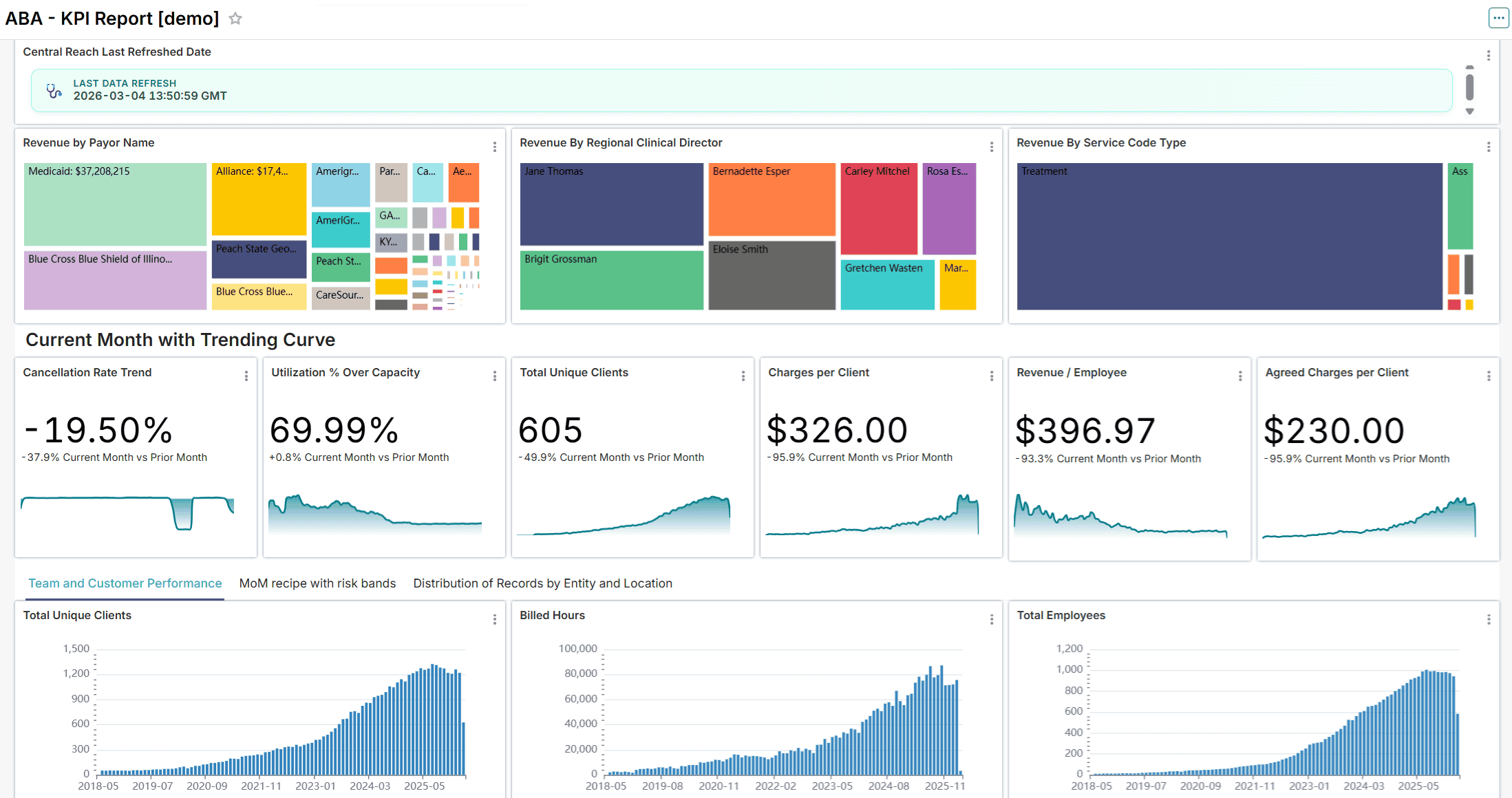
To accurately assess financial health, ABA organizations must track lag-specific metrics alongside traditional KPIs:
- Days to bill (date of service → claim submission)
- Days in A/R
- Clean claims rate
- Denial rate and overturn rate
- Average payment turnaround by payer
- Percentage of A/R > 90 days
These metrics provide a clearer picture of operational efficiency and cash realization — and reveal exactly where the leaks are.
Strategies to Reduce Lag
Addressing billing and payment lag requires both process discipline and accountability. The strongest approach attacks the problem on both ends of the revenue cycle: pre-submission strategies reduce errors and redundancies, while post-submission strategies reduce delay and financial risk.
Pre-submission strategies
- Enforce real-time documentation standards. Hold providers accountable to same-day or next-day session note completion to prevent downstream delays.
- Align authorizations with scheduling systems. Ensure services cannot be rendered outside of valid authorizations.
- Strengthen front-end accuracy. Invest in eligibility verification, benefits checks, and credentialing alignment to reduce denials before they happen.
Post-submission strategies
- Create A/R ownership structures. Assign responsibility for follow-up by payer, aging bucket, or claim type.
- Leverage data transparency. Use dashboards that clearly separate billed, submitted, and collected revenue so leadership always sees the real picture.
Next Steps to Eliminate Lag
Step 1: Get visibility. Start with an Executive RCM Dashboard, designed to use your existing data to give you better visibility into both billed and collected revenue. PlaidCloud offers a “plug & play” option that sits on top of your CentralReach data and delivers clean, decision-ready insight in under a week, at a very reasonable cost.
Contact PlaidCloud ABA Practice Lead at: info@plaidcloud.com
Step 2: Act on what you see. Once you have clear visibility into your financial status, build a plan to address the process and oversight gaps driving cash flow issues. Stephanie Bates Consulting partners 1-on-1 with ABA leaders to use real-time data to identify problems and implement process changes that drive lasting results for your practice.
Contact Stephanie Bates Consulting: sb@stephaniebatesconsulting.com
For ABA providers aiming to scale responsibly, the shift is simple to name and hard to execute. Stop measuring success by revenue generated and start measuring it by revenue converted to cash. Only then can leadership make decisions grounded in financial reality, and reinvest confidently in the clinicians, systems, and supports that shape outcomes for the families you serve.
Financial clarity isn’t a luxury. It’s the foundation that allows your practice to grow sustainably and invest fully in the kiddos and families who depend on you.